Author: Jason

  • Why you can’t believe what you read in spam!

    Had another one passed through today, from a company claiming to offer financial reports of the top 600 companies in that particular business sector, which included the client company they were emailing.

    However, although this particular client has a limited company in the trading name, all of their trading actually went through a different company entirely, so the company details listed in the email, who was apparently performing in the top 600 of that industry (totalling tens of thousands across the UK), actually has the equivalent of a dormant company!

    Would you think it’d be appropriate to provide money to a company starting off with this false information?

    —

    This is why it’s so important to not share your primary email addresses with mailing lists (or anyone who subsequently makes a mailing list out of your details).  Once you’re on the spammer’s list, there’s no escape from junk like the one above (apart from shutting the email address down entirely).

  • Web Designing – spam email

    Although I run Parlour Design, I’m also involved with a number of other businesses too.  One of these businesses has a generic info@ email address (which will get spam, regardless of how well the email address is encrypted on your website).  I’ve advised the client to remove all traces of it, but historically it is still used by some genuine clients.

    They’ve ensured that everywhere the email address was published, is now changed, including the main client website.  However, I do also know that this info@ email address appears on a number of spam mailing lists people can buy into.  It was therefore humorous to receive the following email today:

    Hi
    Hope you are well.
    My Name is Joy, and I am a web consultant with a website design/development firm with offices in the US/UK, and development center in India.
    I was browsing websites from your domain and came across ā€œwww.client-domain-hidden.comā€œ. From what I could notice, your current website does not have an appealing design that visually caters to your client demographic.
    One of the great things about the Internet is that it has leveled the playing field when it comes to competing with the big boys. You have one shot at making a good first impression. With a well- designed site, your little operation can project the image and professionalism of a much larger company. The inverse is also true. I’ve seen many big company websites that were so badly designed and hard to navigate that they completely lacked professionalism and credibility. Good for you, too bad for them.
    Do let me know if you are willing to discuss a possible redesigning of your website, to make it more appealing and comply with the International web standards. In fact, it would be best if you could send in your phone number, location (city) and a convenient time for you to speak.
    Before I end, I thought it may help for you to know that our pricing packages start at USD 199 with no monthly fee and that, we have delivered more than 5000 websites over the past 6 years.
    I look forward to your mail and to speak with you.
    Kind Regards
    Joy
    PS A call now could get you our inaugural discounts.
    Disclaimer: The CAN-SPAM Act of 2003 (Controlling the Assault of Non-Solicited Pornography and Marketing Act) establishes requirements for those who send commercial email, spells out penalties for spammers and companies whose products are advertised in spam if they violate the law, and gives consumers the right to ask emailers to stop spamming them. The above mail spammers-email@gmail.com  and we ensure you will not receive any such mails

    So, apparently, Joy has had a look at the website, and now wishes to help us make it more appealing to web design standards (even though the site has been completely redesigned, optimised, made accessible, etc. in the last two months).

    However, even though she’s apparently ‘seen’ the website, she didn’t use any of the contact details from the website (as the email address she contacted the client on, isn’t listed anywhere on the website), similarly, all the other questions are also answered clearly on the contact page!

    I thought I’d do a quick check on how many times this email has been sent out.. (by taking a copy of a big bulk of text, and putting it in quote marks into Google)… however, rather than finding websites showing this email, I actually found 14 web design companies from around the world, using the same exact words on their own website!  I doubt all these web design companies are the offices mentioned in the email.

    So these guys apparently redesign websites around 1,000 times a year, but they don’t look at them first but want you to contact them with your own details so they can sell you things.  It’s true that the gist of their email is correct.  But for them to claim to be part of the CAN-SPAM movement, send spam themselves, and not actually read anything of the people they contact (just send a generic email to people on a spammers list).. doesn’t give me the impression of an honourable business, just yet more people out to make money on the internet from people who don’t know any better!

  • Making digital content accessible by everyone

    Thankfully, the Government, industry workers, and members of the voluntary sector have come together in an eAccessibility forum, to develop an action plan to help make digital content accessible by more users.

    Parlour Design works hard to ensure all their websites are accessible in a wide variety of formats, using:

    • Logical page structures for all the content (even with style sheets switched off),Ā 
    • Not using ‘flash’ animation for layout or content purposes (just for pleasing design aesthetic features)
    • Always using ‘alternative text’ for images (and only then when text is not appropriate in the first place).
      • (rather than the common technique by many designers of using images for text, because they’re being lazy designers and can’t work out how to make the text appear how they want to, in it’s pure form!).
    • Placing the bulk of navigational links at the base of the page (even if on display, it seems to be before the main text)
    • Helping the page render differently, depending on the type of browser being used.
    • Using flexible font sizes (rather than fixed pixel dimensions), so users can easily increase the size of any text with a simple mouse action.
    Thankfully, this particular group mentioned at the outset are also working on expanding the roll out of these simple methods, along with many other ideas as featured in this initial report:
    (The report is also due to be updated every 3 months, with new developments).
    One key area I was interested in, is point 3, Website Services:

    3. Websites services work stream

    Websites are the gateway to almost every business, voluntary organisation, or provider of information about public services. Whether or not they are direct sales and marketing tools, they are key contributors to the financial efficiency of each body. A well designed website draws in more users, and reduces the need for other means of customer support such as call centres. Although there are internationally recognised standards and guidelines of website accessibility, these are poorly adhered to by the public sector or by the private sector. This work stream will explore the reasons for this and assist both government and private sector to develop websites and online services that conform appropriately to web standards, guidelines and best practices, such as WCAG 2.0 AA and relevant W3C specifications. It will also take forward plans for a One Stop Shop for information on eAccessibility, and look at how the website designers of tomorrow can be trained to design accessibility into their products and services.

    I’m very often so disappointed with the incredibly poor ‘housekeeping’ of so many website developers, and just how much extra code has been thrown in to most of the source code, particularly when using ‘design software’ to try and make things look like they think (rather than understanding the language behind it, to just use the ‘pure ingredients’).

    I look forward to the further adoption of these developments, and seeing how the working party get on.
  • Super fast broadband nationwide by 2015

    You may have heard in the news today that the government is trying to get everyone in the UK (including rural areas) access to super fast broadband in the next five years.

    Obviously, this will be of great benefit to the online world as such, and will enable a great degree of rich website content (with video streaming, faster downloads, etc.), also paving the way for increasingly popular technologies like TV on demand, and interactive contents.

    For those who have been using broadband for a while (I’ve personally had broadband for 10 years, and was one of the first 1,500 BT Broadband customers!), almost no-one would go back to dial-up now.

    I was fortunate to meet a very senior person within the telecommunications industry a few months ago, who helped explain to me how this could be achieved, (as I was puzzled over the knowledge that broadband quality decreases significantly, depending on your copper cable distance from the phone exchange.  similarly, it wouldn’t be affordable to run fibre optic cable many km to just one house in a remote valley).

    As you may know, from 2012 analogue tv is being switched off entirely (many parts of the UK are already digital), and when this happens, the digital signal will actually become stronger (because the analogue signal, interferes with the broadcasting of the digital signals, from the same arial).

    Because the analogue signal uses up quite a large portion of frequencies for TV (ie like your FM radio broadcasts on a range of frequencies), when the digital switch happens, because digital can be broadcast on a smaller isolated frequency, it opens up a lot of spare frequency space.  Which can be reused.

    In the more rural areas, you might also already be aware of satellite phones (that enable two way communication with satellites, virtually anywhere in the world).. well this same type of technology will also enable very fast broadband speeds in rural homes (and is capable of speeds much greater than we can can currently get via cables at the moment in the UK).

    All this means that my dream of living in a remote sustainable farmhouse in the valleys of North Wales, whilst maintaining my website design and development on-line, will soon be a real possibility! šŸ™‚

  • Encouraging Recycling

    Having recently taken over a hotel (accommodating for up to 16 guests 7 days per week), so far we’ve managed to reduce our landfill by at least 85%.Ā We still have further to go, which will be progressing over coming months, but it’s a pretty good start.

    This was quite simply achieved by seperating our rubbish, and putting most of it to recycling.Ā  (ie down from an 1,100 litre dumpy bin, to the equivalent of around 2 dustbin bags a week of landfill: less than the average families landfill I see at the side of the road).

    For example we now recycle:

    • all suitable paper and card
    • recyclable plastics (numbers 1-5), metals and tins
    • recyclable glass
    • tetra-pack cartons (lids seperated)
    • Tassimo disks from our various machines at the hotel (2p for each one recycled also goes to charity)
    • Nespresso capsules (recycled by Nespresso directly).

    We also:

    • Reduced food wastage by cooking great food, to order (so there’s also less left by our guests)
    • Buy only fsc approved toilet and facial tissues (ie recycled, and/or sustainable)
    • Use energy saving bulbs throughout most of the hotel (both halogen, and tube style)
    • Turn off thermostats in our rooms when they’re not booked
    • Open windows to naturally air the place as much as possible (rather than just using chemicals)
    • fix leaking taps, etc

    We’ve now found a suitable commercial recycle company, who can collect much our recyclable materials on a fortnightly basis.  Those items they can’t recycle directly, but we can, we still keep aside and recycle ourselves through other companies.

    We also reduced the visits by the waste companies (fortnightly or less), to reduce the environmental impact of their travel to us in their large heavy vehicles.

    It’s unfortunately, that in my experience, most businesses aren’t willing to take these steps to reduce their environmental impact.

    I do appreciate there is still a lot more we can do ourselves (and already have plans to do so), and we’re trying to maintain the balance of luxury and quality with our environmental impact.

    However, speaking to the guy changing over our dumpy bin recently (to one much smaller), he was also sharing how for the farm he also works on, they are still heavily discouraged by price.

    For example, on his farm, plastic bags and wrapping (from feed, etc.) can either be recycled, or put in a skip for landfill.

    • If they put it in the skip, and it goes straight to a hole in the ground, they get charged around Ā£200 a year.
    • If they collect the same volume for recycling, it’s around 3 times that price!

    Not surprisingly, and unfortunately, for immediate cost reasons they therefore choose to put it all in landfill.

    I also remember, back in 2001 when I used to work in a call centre in a town centre, virtually all the rubbish we ever disposed of was shredded office paper.  At that time, business landfill waste was free.  Recycling the premium paper however was quite a considerable cost in addition!

    Until these basics change, I can’t see many other businesses taking steps to reduce their environmental impact.  I haven’t seen the figures, but I’m sure it will make a significant difference if more businesses are encouraged with their bottom line, to change.

    It doesn’t take much once the changes are made, the biggest challenge seems to be in the change in work practices initially.  Trial it for a couple of weeks if you need to (even if you still keep sending it to landfill), and when it works, you can make it company policy on a constant basis!

  • Don’t be fooled by appearances

    If you’ve met me, you might recognise that I generally look around 5-10 years younger than my age, I smile a lot, if I’m out and about I’m likely to have a rucksack on my back, and I tend to wear practical clothes rather than fashionable.

    However, I’m also involved various businesses that continue to grow around the UK, with currently a turnover of thousands of pounds a year (and so of course spend quite a lot of money with a lot of different suppliers from around the UK), so when I buy things, I tend to buy in bulk.

    My recent experience:

    Very recently however, whilst walking around my new local town, I happened to notice a small independent interior designers shopfront.Ā  Knowing that our new hotel is likely to be going through some significant internal renovations next year, I dropped in to have a look around, and discuss the potential of working together.

    The lady in the store was already busy on the phone when I walked in.. so I didn’t rush her, but perused the small collection of fabrics and samples on display whilst waiting.

    She didn’t seem like she’d be off the phone anytime soon, and hadn’t made any efforts to let me know she’d be right with me.

    I then spotted a hardback interior design book on one of the chairs, so picked it up to get some further ideas to discuss.Ā  Flicking through the pages, I then spotted something tucked into the book, which looked very out of place, and quickly spotted it was a printed boarding pass for a flight that month.Ā Trying to glance through to find out if this would be too late to get it to the owners (who must have left it by mistake), or whatever else I may be able to do to reunite it.

    However, just then, the lady of the store (whilst still on the phone), snatched it out from my hands, told me not to touch it. She then quickly folded the paperwork back in half, and put it back in the book (by which time she’d also snatched this out of my hands).  She then put the book back on the chair, and then walked back into the rear of the store to continue her discussion on the phone (who I could work out was a long term supplier).

    Not surprisingly, I left the store.

    Realising that a lot of people don’t always get to know what they might have missed, that day I wanted to let her know.Ā  Therefore, with a smile in my step, and arms full of shopping (ā€˜Pretty Woman’ style) I returned around 45 minutes later, sharing some information:

    1. I do own a small, local, luxury boutique hotel;
    2. We were looking to spend up to around £20,000 on some interior work (particularly on the design and finishing),
    3. And that unfortunately, due to the way I’d been treated by her a little earlier, there was absolutely no way I would now consider working with her or her company.

    She was of course apologetic at this point, but it was too little : too late.

    This incident is certainly not isolated.

    A very successful friend had just been decorating her own new home, in a very expensive part of Guildford.  Remembering her dental needs, still partially covered in clothes caked in paint, she tried to register with a very local but expensive private dentists.  The receptionist apparently wouldn’t even give her the time of day.  But upon returning later that week, this time on her return from work (in a tailored suite), they couldn’t sign her up quickly enough.

    Similarly, a good colleague who now runs fleet services for a well known luxury car company:  shared with me a time one Saturday afternoon when a gentleman in casual jeans and a t-shirt turned up at the showroom and forecourt of the car firm, and was taking a good look around.  The high pressure sales guys at the time didn’t take long to assume he was just going to waste their time, so they sent over the Saturday kid (John) who was trying to learn the sales trade whilst washing the cars.  The gentleman had a few questions, that the kid tried to answer as best he could.  The gentleman then asked how he could go about ordering 14 of these for his business.

    Not surprisingly, the Saturday kid didn’t really know how to proceed, so went back to asked the main sales guys what to do next.. on hearing the news, they elbowed their way into trying to get the commission, but the gentleman in question stopped them, explained that they had all dismissed him whilst he was walking around and whilst trying to ask questions, and so John (the Saturday kid) was the only person who should get the commission from the significant sale.

    Incredible people:

    Now being a hotel owner / manager, I’m fortunate to meet many incredible people from around the world who have come to stay with us.

    Over the course of their stay, some of them are kind enough to share with me their background, and we do get all types of people.Ā  Some are nurses, midwifes, and teachers, others are mutli-millionaire business owners, some travellers are expanding, retiring, or just keeping busy.Ā  All of them look much the same, especially when they come down for breakfast in the hotel dressing gowns.

    Don’t judge a book..:

    Apparently 40% of the decision to buy a book is based on its cover alone, but they do still say: ā€œdon’t judge a book by its coverā€.

    When it comes to people especially, basing your opinion on image alone, more than likely you’ll be completely wrong.

  • Interflora Vs Marks and Spencer – Adwords row

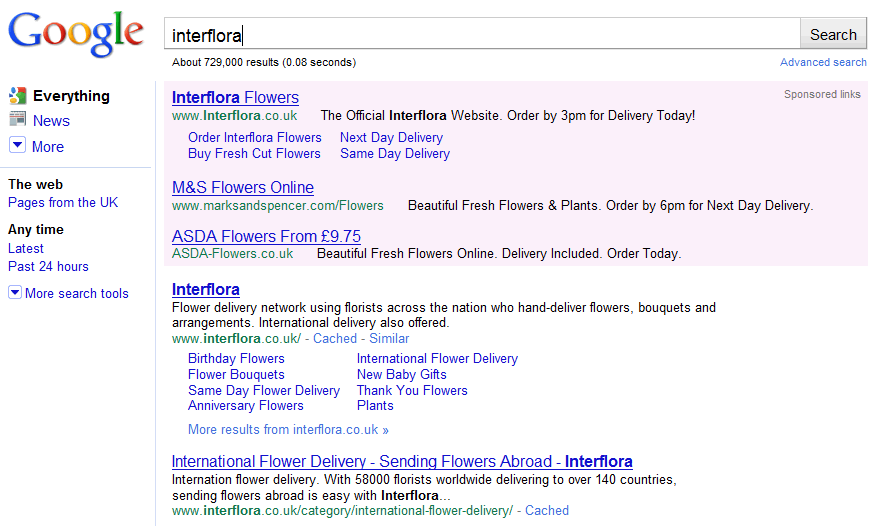
    Some of you may haven heard in the news today about the Interflora Vs Marks and Spencer row, over the use of the search term ‘Interflora‘:

    This screen clipping was taken a few moments ago, and as you can see, in the ‘sponsored adwords’ listing, both Interflora, M&S, and ASDA are all bidding on the search term ‘Interflora’, in the ‘Pay Per Click’ ‘sponsored links’.

    Firstly, from the people I’ve already spoken to today, there is some misunderstanding between paid listings, and natural listings:

    • Natural listings are the search results that appear with a white background, on every search results page. Ā Whereas sponsored listings are paid for advertising links (which may or may not take you to the product or service you’ve searched for).
    • Natural Search listings can be improved through having a great website, and naturally working on your Search Engine Optimisation (SEO). Ā This are the most valuable placements to have, as many users will prefer to click on the natural links, rather than the paid links.
    • The PayPerClick (PPC) advertised listings, as seen in the above example (with the faintly shaded background) are the search results which either appear above, or to the top right of every search page.Ā 
    • With PayPerClick, Companies can thus pay Google (which is part of the reason the stock value of Google is so high) to appear high on this listing.. the more you offer to pay Google for each person who clicks on your link, the higher in the rankings you will appear.

    The minimum bid is 1p (or in reality it’s more like 2p), but there is no upper limit I’m aware of (you just need to work out the value to yourself of someone clicking through..

    • If you have a product that sells for Ā£10, and you make Ā£1 profit on each item: if 10% of the visitors to your website purchased one item, then the value to you of each click would be 10p (so you’d need to set your bid to a lower value to ensure you can still cover your costs, unless of course this Ā£10 product is a ‘loss leader’ to help get customers to buy other products too).
    • However, if your product sold for Ā£10,000, with a Ā£2,000 profit margin, and 10% of the visitors who visited your site from your chosen search term, then the average value of each click would be Ā£200, so the amount you bid on each click could of course be much higher.

    This is the reason why companies cold call many businesses, and guarantee you ‘first page on Google’.. this is easy, if you pay enough for the relevant search term, you can appear as high as you like for those search terms.

    However, the interesting thing about this case is that Marks and Spencer are using a worldwide registered trade-mark as a means to promote their own competitive services (even though the trademark phrase itself doesn’t appear in the advert, nor on the associated page with it).

    I know that Red Letter Days used to be very clear to their resellers, that as part of the agreement to resell Red Letter Day vouchers, the resellers were not allowed to bid on the search terms directly related to their brand (ie ‘Red Letter Days’).  However, in this case, M-and-S have not entered into such an agreement, as they are attempting to sell their own competitive product/service instead.

    So it’s understandable for the case to now reach the high court.  Trademark and Copyright rows are rarely simple.
    By my understanding, you are typically only allowed to quote someone else’s trademark; with their permission, if you are a licensed reseller of their product (ie Starbucks coffee), or for a news feature or similar.

    But then, many trademarks/brand names have become a generic description of a product (ie ‘Tannoy’ rather than a ‘public address system’, ‘Hoover’ rather than ‘vacuum cleaner’, etc.) so in these cases, you could argue it would be ‘fair’ to associate your competitive product or service with such a name.

    I look forward to seeing how the case continues.

  • New Xtrahair website

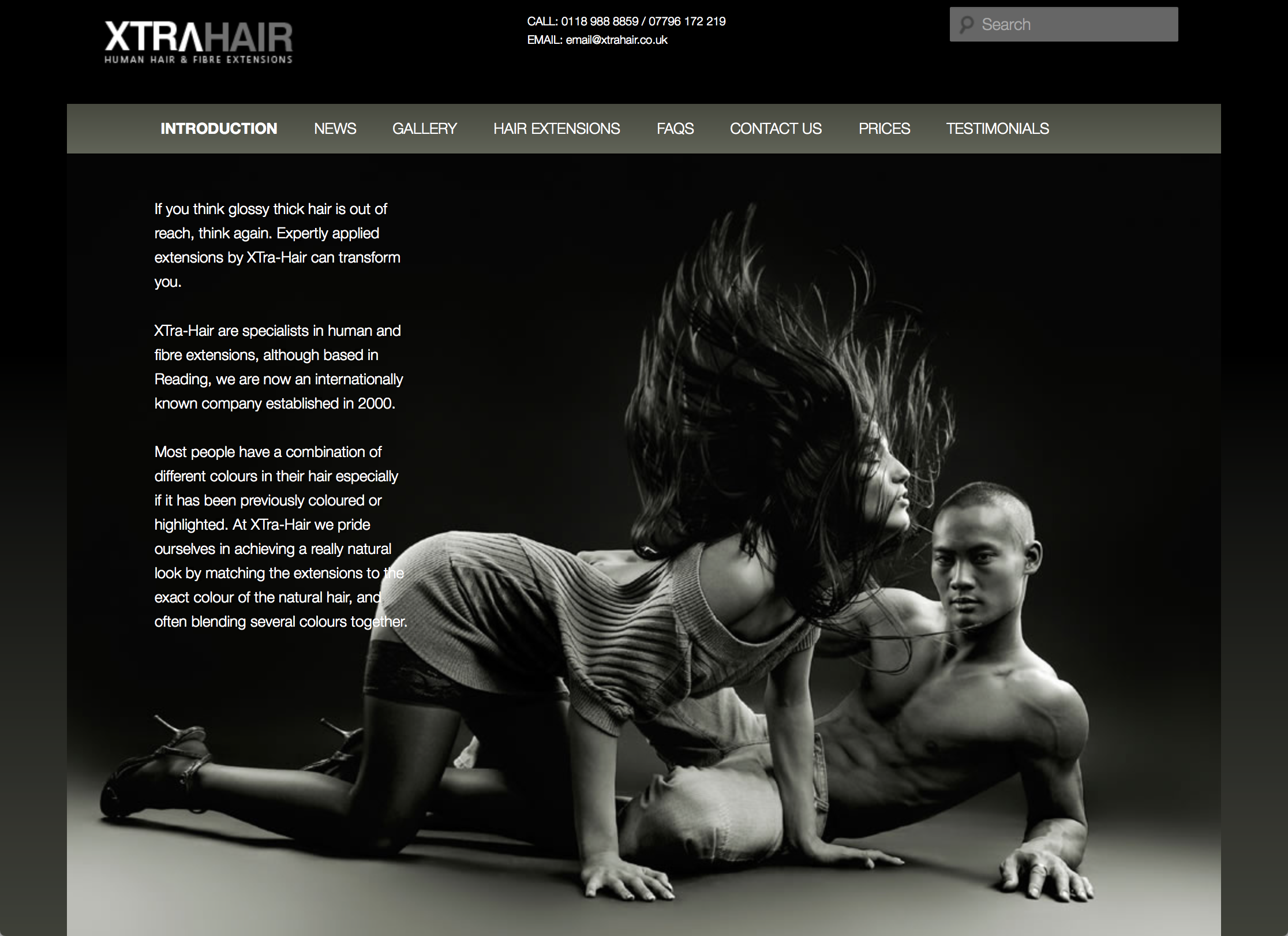
    I’m very pleased to announce the launch of the new Xtrahair website.

    XtraHair

    As you can see, this is a very fresh looking design, with a conceptual design by our great colleague Matt.

    In the process, he also wanted to update the Xtrahair logo, as seen.

    The site is now also in the hands of the client, who has the facility to update each page of her website through an integrated content management system (CMS).  And of course, we’ve kept the old blog on their too (but now restyled it to fit in with the new design).

    Certainly quite a significant improvement on the old design!

    xtrahair old website

    If you’d like us to improve your current website, or if you’d like a new one built entirely from scratch, do let us know.

  • New ‘written contract’ now available through our website

    To help keep things clear to our clients, we’ve just added a new plain English written contract, to our website.

    This was very kindly provided, under the creative commons licence, by Andy Clark of Transcending CSS. Ā We’ve subsequently modified his version to fit more appropriately within our own policies and procedures, but are very grateful to Andy for his excellent direction in this, and of course his inspirational book:Ā ‘Transcending CSS, the fine art of web design’.

    Many thanks Andy.

  • An excellent wedding photographer – Jasmine Star

    I’ve just been fortunate enough to discover the website of a really excellent wedding photographer, Jasmine Star.

    I first discovered the wedding section of her blog www.jasminestarblog.com, and was just so impressed with the quality of her images, for each and every wedding collection she’s displayed.

    They have a real truth, beauty, naturalness, art, and technical skill that I so rarely see combined by a single person. She’s clearly passionate about her work, and excellent at what she does.  I’m sure she’ll have an incredible career ahead of her.

    If you’re a particularly observant type, something you may notice from her wedding blog, is that the large selection of around 100 images displayed, are all just from the last few weeks!  (whereas many photographic websites will only make available a very small selection from each event).

    Very impressive, very inspirational, and well worth a look.

    If you’re in the area, and/or can afford to fly her over for your wedding, it looks like money very well spent!

    Thank you Jasmine.